
 the siteTry the demo: a personal space, no sign-up required, automatically deleted after 24 hours.
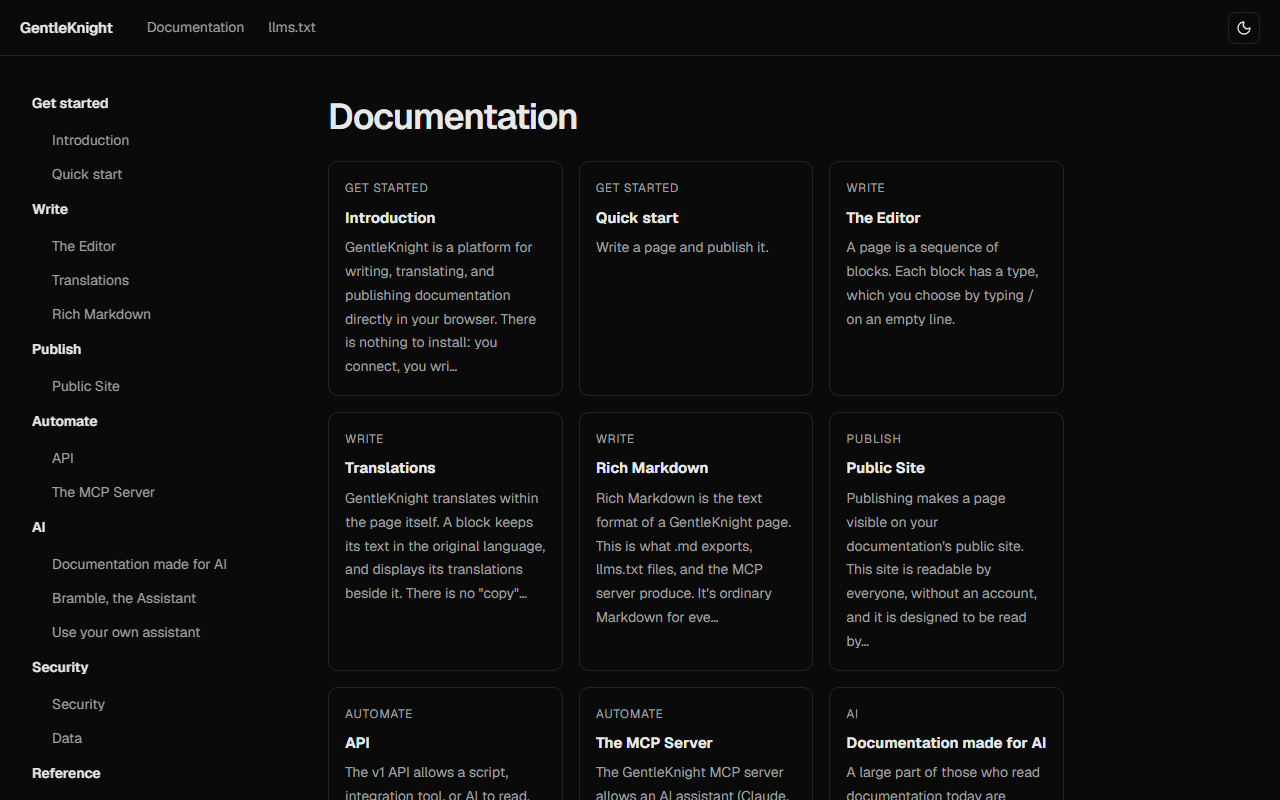 DocumentationConsult the guide and GentleKnight resources.
Why our own system
The core idea is simple: stop relying on external tools to write, organize, and translate what we know about our products. A homegrown tool also means the freedom to add exactly what we need, when we need it.
Production must serve documenting our own projects, Vyse and Miner's Run. The demo, meanwhile, is open to everyone.
Documentation for us, translated by us, end-to-end.
Writing in blocks
Each page is a sequence of blocks, like in Notion. Rich text is stored as structured content with its marks, links, and tooltips intact, so nothing is lost between the editor, preview, and public view.
- a projectmembers, roles, languages, formats
- a documenta section of the documentation
- a page
- a blocka value per language
Translate without losing the thread
A block's text exists once per language; the page structure is common to all. Each translation keeps the source revision it rests on. When the original text changes, it goes 'needs review' instead of silently becoming wrong. Code, commands, and images are not translated.
- the original text is modifiedits revision increases
- translations go 'needs review'
- the translation is updated
- the percentage is recalculated
The same system works beyond documentation: on Discord, on websites, and in Minecraft, with their formats (MiniMessage, Discord Markdown), without formatting lost along the way.
One format, one implementation
Rich text has a single implementation, written in Rust. The same code runs on the server and in the browser, compiled to WebAssembly: no more TypeScript conversion on one side and Kotlin on the other. Its text form, Rich Markdown, serves exports, AI, and the MCP server.
- a single format
- a given piece of content always writes out in exactly the same way
- no loss
- writing then rereading yields exactly the original content back
- no guesswork
- an ambiguous input is rejected, with line and column reported
Readable by AI
A Rust service serves the public site and everything intended for machines: the Markdown of each page, llms.txt, llms-full.txt, llms.json, and the sitemap. In a given language, llms.txt lists only pages that actually exist in that language.
An MCP server, also in Rust, allows an assistant to read, write, and translate project documentation using a token specific to that project. A modification is made via exact citation: if the cited text is missing or ambiguous, it is rejected. Publishing is marked as sensitive; the assistant asks first.
search · fetch · list_pages
create_document · create_page
edit_page       "old text" → "new text"
translate_page  a translated copy, block by block
publish_page    sensitive: ask first
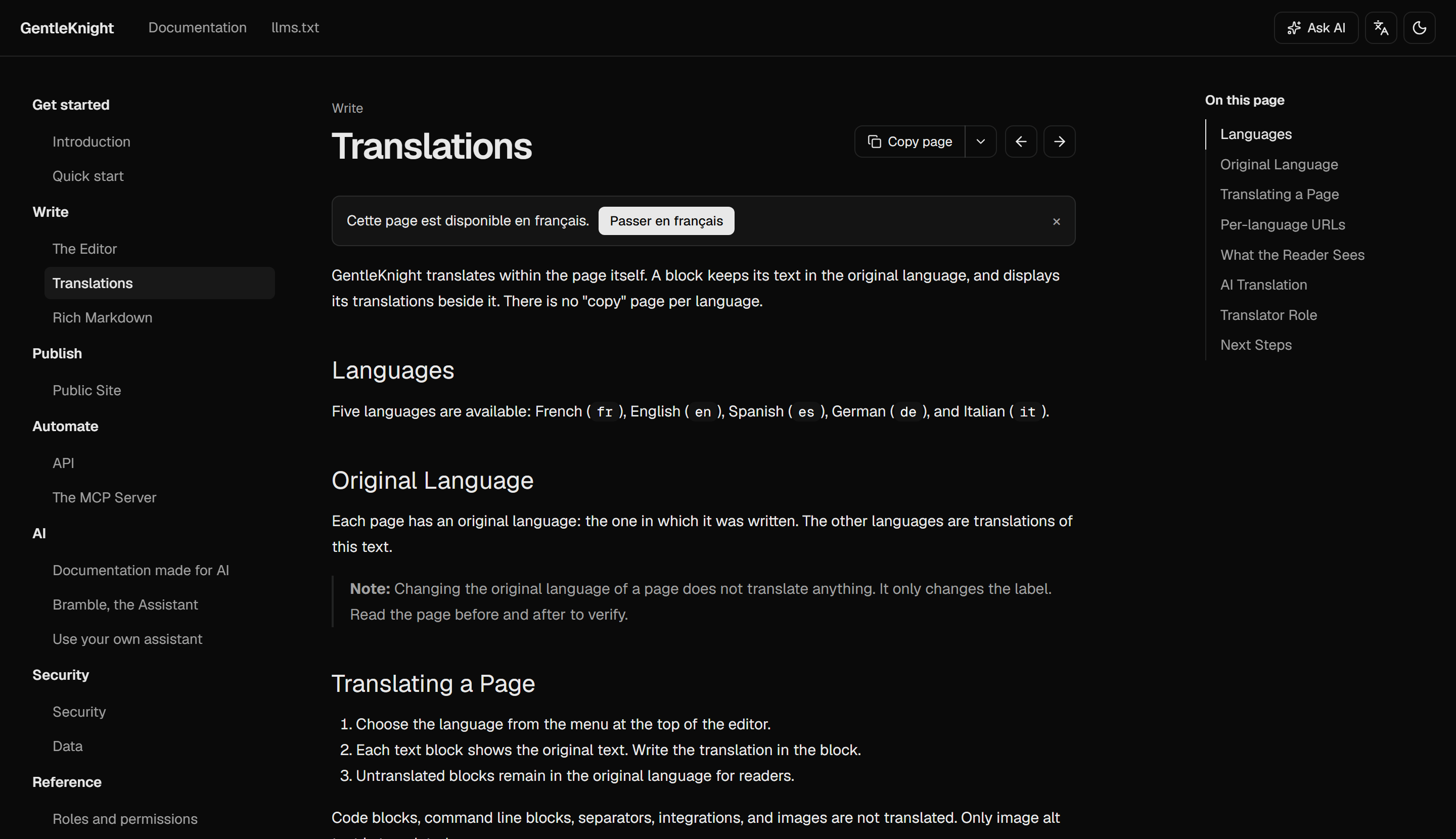
The pages of the captures above were written, then translated, by this MCP server.
Roles and access
- owner
- everything, including members and API tokens
- editor
- edit content and publish
- translator
- translations only, verified on the server
- reader
- read-only
Access rules fit within a single tested function; sessions are HttpOnly cookies where only the hash is stored, just like API tokens.
Hosted by us
The core runs on Kotlin and Spring Boot with MongoDB, the interface on Next.js, and the format and publishing service on Rust. The demo and production run on the same machine, each with its own database, ports, and settings. GitHub Actions deploys the demo on every push and production on every release.
MongoDB and the core communicate only over Docker's internal network
What comes next
- collaboration
- several people editing the same block, with Ctrl+Z undoing only their own changes
- history
- who changed what, when, and through which channel: editor, API, or assistant
- assistant
- questions and answers about the docs from the public page, Discord, or Minecraft
- formats
- extensions for importing existing content, including MiniMessage
The project is still under construction. This page describes the intent and current state, not a list of finished features.
Built with
- format and publishing
- RustWebAssembly
- infrastructure
- GradleDockerGitHub Actions